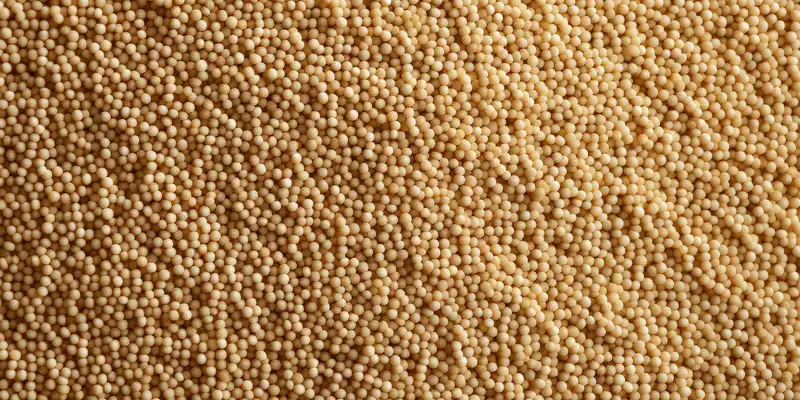
Quinoa - nutritional value information and benefits
* refine tags for better results
per 100g, % - from average daily nutrient intake
10%
244 kcal
Calories
12%
9 g
Protein
13%
43 g
Carbohydrate
4%
4 g
Fat
General nutrients
Key components of food that provide the body with energy and all the necessary substances for life, growth, and normal functioning.
Water 42.45 g
2%
Calories 244.00 kcal
10%
Protein 9.26 g
12%
Fat 4.00 g
4%
Ash 1.57 g
-
Carbohydrate 42.73 g
13%
Carbohydrates
The main source of energy. Read more
Fiber 4.90 g
Sugars 0.87 g
Starch 34.93 g
Minerals
Support metabolism, bone formation, nerve impulse transmission, water-salt balance, and immune function. Read more
Calcium Ca 32.00 mg
3%
Iron Fe 3.03 mg
30%
Magnesium Mg 130.50 mg
32%
Phosphorus P 304.50 mg
43%
Potassium K 367.50 mg
7%
Sodium Na 6.00 mg
0%
Zinc Zn 2.10 mg
19%
Copper Cu 0.39 mg
43%
Manganese Mn 1.33 mg
57%
Selenium Se 5.65 mcg
10%
Vitamins (fat-soluble)
Important for metabolism, growth, and regulation of bodily functions. Read more
Vitamin A 0.50 mcg
0%
Retinol 0.00 mcg
0%
Beta-carotene 5.50 mcg
0%
Alpha-carotene 0.00 mcg
0%
Beta-cryptoxanthin 0.50 mcg
-
Lycopene 0.00 mcg
-
Lutein and zeaxanthin 108.00 mcg
-
Vitamin E as alpha-tocopherol 1.54 mg
10%
Vitamin D as D2 + D3 0.00 mcg
0%
Vitamin K1 Phylloquinone 0.00 mcg
0%
Vitamin K2 Menaquinone-4 1.10 mcg
0%
Vitamins (water-soluble)
Participate in energy metabolism, nervous system function, and cell growth. Read more
Vitamin C Ascorbic acid 0.00 mg
0%
Vitamin B1 Thiamin 0.23 mg
19%
Vitamin B2 Riboflavin 0.21 mg
16%
Vitamin B3 Niacin 0.97 mg
6%
Vitamin B4 Choline 46.60 mg
9%
Vitamin B5 Pantothenic acid 0.77 mg
15%
Vitamin B6 Pyridoxine 0.31 mg
23%
Folic acid 0.00 mcg
-
Food folate 113.00 mcg
28%
Vitamin B9 DFE 113.00 mcg
28%
Vitamin B12 Cobalamin 0.00 mcg
0%
Amino acids
Participate in the synthesis of proteins, hormones, enzymes, and neurotransmitters. Read more
Betaine 630.40 mg
-
Tryptophan 0.11 g
13%
Threonine 0.28 g
11%
Isoleucine 0.33 g
16%
Leucine 0.55 g
11%
Lysine 0.50 g
12%
Methionine 0.20 g
11%
Cystine 0.13 g
7%
Phenylalanine 0.39 g
8%
Tyrosine 0.18 g
3%
Valine 0.39 g
15%
Arginine 0.72 g
11%
Histidine 0.27 g
12%
Alanine 0.39 g
5%
Aspartic acid 0.74 g
6%
Glutamic acid 1.22 g
8%
Glycine 0.45 g
12%
Proline 0.51 g
11%
Serine 0.37 g
4%
Saturated fatty acids
Provide energy and participate in the construction of cell membranes and hormones. Read more
Saturated fatty acids 0.47 g
Butyric acid 0.00 g
Caproic acid 0.00 g
Caprylic acid 0.00 g
Capric acid 0.00 g
Lauric acid 0.00 g
Myristic acid 0.00 g
Pentadecylic acid 0.00 g
Palmitic acid 0.40 g
Margaric acid 0.00 g
Stearic acid 0.02 g
Arachidic acid 0.03 g
Behenic acid 0.03 g
Lignoceric acid 0.01 g
Monounsaturated fatty acids
Support cell health, improve blood lipid profile and metabolism. Read more
Monounsaturated fatty acids 1.07 g
Myristoleic acid Omega-5 0.00 g
Pentadecanoic acid 0.00 g
Hexadecenoic acid 0.00 g
Margarolic acid 0.00 g
Octadecenoic acid 0.94 g
Gondoic acid Omega-9 0.06 g
Erucic acid Omega-9 0.06 g
Nervonic acid Omega-9 0.02 g
Polyunsaturated fatty acids
Essential components involved in maintaining cell membrane flexibility, regulating inflammation, cholesterol levels, and hormonal balance. Read more
Polyunsaturated fatty acids 2.19 g
Octadecadienoic acid 1.98 g
Octadecatrienoic acid 0.17 g
Stearidonic acid Omega-3 0.00 g
Eicosadienoic acid Omega-6 0.00 g
Eicosatrienoic acid 0.00 g
Eicosatetraenoic acid 0.01 g
Eicosapentaenoic acid EPA Omega-3 0.00 g
Adrenic acid Omega-6 0.00 g
Docosapentaenoic acid DPA Omega-3 0.00 g
Docosahexaenoic acid DHA Omega-3 0.03 g
Sterols
Important components of cell membranes that regulate their fluidity and permeability. Read more
Cholesterol 0.00 mg
Other
Other bioactive compounds that affect physiological processes but do not belong to the main classes of nutrients.
Ethyl alcohol 0.00 g
Caffeine 0.00 mg
Theobromine 0.00 mg